Investigation into the Clutter family killings
In Cold BloodThe investigation into the Clutter family killings transformed an apparently motiveless, nearly clue-less crime into a case built from uncertain hypotheses, testimony, and physical evidence. Led by Alvin Adams Dewey, the inquiry expanded from the Finney County sheriff’s office into a statewide effort, moving between the Clutter family’s relationships and routines, possible suspects, and the traces left by the killers. Its progress depended not on one decisive clue but on testing what could be established against what remained conjecture.
Taking Charge of an Unclear Case
The first days of the investigation unfolded amid a sharp contrast between familiar community life and the crime’s aftermath. On Monday, November 16, 1959, Andy Erhart and three of Herbert William Clutter’s longtime friends returned to River Valley Farm, where they had often hunted pheasants together. This time they brought cleaning supplies and old clothes to help clean rooms in the house. A highway patrolman waved them through the barricade at the farm entrance, and Alfred Stoecklein, the employee who lived on the property, let them in. Erhart had known Herbert William Clutter since their days as classmates at Kansas State University; the task brought the investigation’s human loss into view even as the house remained under official control.
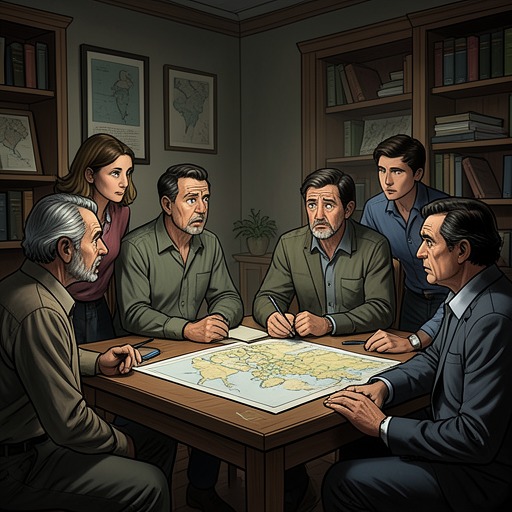
The Kansas Bureau of Investigation had nineteen experienced detectives distributed across Kansas, available when local authorities needed assistance. Its Garden City representative, Dewey, was a forty-seven-year-old fourth-generation Kansan, a former Finney County sheriff and former Federal Bureau of Investigation special agent. Sheriff Earl Robinson asked him to take charge. The assignment was professionally appropriate, but also personal: Dewey and Marie Dewey had known and liked Herbert William Clutter and Bonnie Clutter, whom they saw at church and visited. Dewey made clear that solving the crime was a commitment independent of that friendship. As the case developed, eighteen men were assigned to it full time, including Kansas Bureau of Investigation special agents Harold Nye, Roy Church, and Clarence Duntz. Dewey regarded the arrival of the three as the formation of a strong team.
The case quickly drew reporters to Garden City, Kansas. At a Monday midday press conference, Dewey separated established facts from theories. Four members of the family had been killed sometime between late Saturday night and early Sunday morning, but the coroner could not establish the sequence. Investigators did not yet know which victim, if any, had been the primary target. Dewey also told the press that the women had not been sexually assaulted and that nothing was then known to have been stolen. He acknowledged Herbert William Clutter’s recently purchased life-insurance policy, worth forty thousand dollars with double indemnity, but saw no plausible connection: the surviving beneficiaries were his two elder daughters. He withheld his view on whether one or two perpetrators had been involved.
Competing Theories and Early Leads
Dewey’s reconstruction initially had two forms. Under the single-killer theory, the offender would have needed some knowledge of the family and the house: which rooms they occupied, where the telephones were, and how the household was arranged. Dewey considered how such an intruder might have entered, disabled the telephones, and controlled the family. But the hypothesis had serious difficulties. Herbert William Clutter and his son Kenyon were both physically strong, and Dewey questioned whether one armed person could have subdued them. The same kind of half-hitch knot had been used to bind all four victims, a detail that did not settle whether one person or more had done it.
Dewey and most of his colleagues leaned toward a second theory, in which an accomplice helped control and bind the family. That possibility raised another problem: investigators could not easily explain how two people might share the degree of rage the crime appeared to require, or why an ordinary person with a grievance would find a partner willing to participate. Neither model resolved the case. Theories about a personal grudge and robbery remained in competition, and the absence of an intelligible motive made both difficult to confirm.
Two early leads seemed to support the possibility of a grievance. Duntz heard about a father and son, known in the account as John Senior and John Junior, who had previously clashed with Herbert William Clutter. After a minor business dispute, the two men had gone to the Clutter home intending to confront him. Herbert William Clutter, who opposed drinking, had driven them off the property at gunpoint; John Senior was later reported to have remained angry. Church learned of another hostile man, identified under a false name as Mr. Smith, who believed that Herbert William Clutter had shot his hunting dog. Church also noticed a length of rope at the man’s farm tied in the same type of knot used to bind the family. These were leads, not proof. Dewey treated a grudge as one possible explanation, while Nye continued to question whether robbery could account for the scene.
The robbery theory had evidence on both sides. Herbert William Clutter was known locally to avoid keeping much cash, had no safe, and did not carry large sums. Mrs. Clutter’s wedding band and diamond ring remained with her, facts that seemed difficult to reconcile with an ordinary theft. Yet her purse was on the kitchen floor, Herbert William Clutter’s wallet was found open and empty on his bed, and almost no cash was found in the house. The family had expected that more money might remain from a check cashed the day before. Investigators therefore had to consider whether money had been taken, whether the apparent signs of theft were misleading, or whether robbery was not the motive at all.
Searching the House, Records, and Community
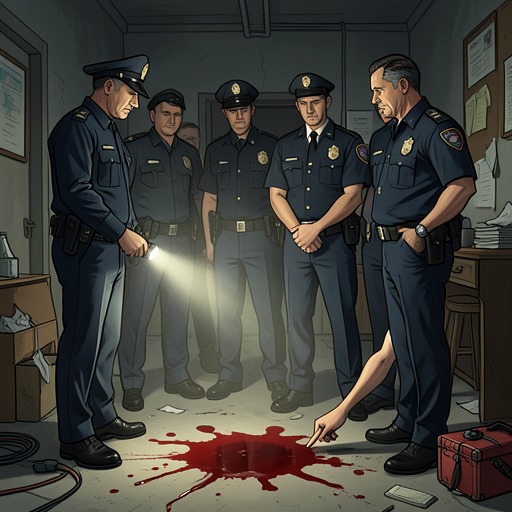
Dewey’s temporary office in the sheriff’s department became a working archive. On his desk were the cord and adhesive tape taken from the victims, sealed in plastic, along with twenty enlarged photographs made at the scene. The materials were commonplace and, by themselves, seemed unlikely to identify anyone. Dewey repeatedly studied the photographs in the hope that a concealed detail would become visible. One image had already disclosed footprints on the cardboard covering of a mattress: dusty impressions with diamond-patterned soles, along with a distinct Cat’s Paw half-sole print. The investigators considered these among their only serious physical clues and kept their existence from the public.
Nancy Clutter’s five-year diary offered a different kind of evidence. Dewey read its final entry first: written shortly before her death, it recorded an ordinary evening that included a visit from Jolene Kidwell, baking instructions, practice with her horse, and time watching television with Bobby Rupp, who left at eleven. Rupp, the last person known to have seen the family alive, had already been interviewed and was due to be questioned again and given a polygraph test. Dewey did not believe he had been involved, but early in the inquiry Rupp was the only person to whom investigators could tentatively attach a motive. The diary described Herbert William Clutter’s objection to the young couple’s relationship because the families belonged to different Christian denominations.
Another diary entry led Dewey to consider a more obscure possibility. Nancy had written that her favorite cat, Boobs, had died and that she suspected it had been poisoned. She had buried the animal in a special place on the farm. Dewey wondered whether the cat’s death might have been an earlier act of malice connected to the killings and resolved to search the extensive property for its burial place. The diary did not establish that the cat had been poisoned or that the incident was connected to the murders; it gave investigators a question to pursue, not an answer.
Meanwhile, Church, Duntz, and Nye canvassed the area. They spoke with staff at Holcomb School, where Nancy and Kenyon had been excellent students; workers at River Valley Farm; friends and neighbors; and relatives arriving for the funeral. Nye was assigned the difficult task of interviewing the Clutter family’s kin. He explored possible emotional conflicts, including the possibility of a romantic triangle, but neither the relatives nor the surviving daughters supplied a useful explanation. The inquiries instead reinforced how little the investigators knew about why anyone would target the family. Among the agents’ early leads, the suspects with apparent personal grievances did not yield a confirmed connection.
Floyd Wells and the Plan Behind the Crime
A crucial lead emerged from Dick’s former cellmate, Floyd Wells, who had worked for Herbert William Clutter on the western Kansas farm. Wells recalled that Dick spoke repeatedly about a wealthy wheat grower he had learned about through their prison conversations. Dick asked about the family, the children’s ages, the route to the house, its layout, and whether Herbert William Clutter kept a safe. Wells told him that he did, relying on a mistaken recollection of a cabinet or similar object in the office. Dick then described a plan to rob the house and kill witnesses, naming Perry Smith as his intended partner. Wells had treated the talk as prison boasting rather than a plan likely to be carried out.
After learning of the killings, Wells followed news reports but hesitated to go to the authorities. He feared retaliation from other prisoners and worried that officials might regard him as an accessory because his information had directed Dick toward the family. A newspaper’s offer of a thousand-dollar reward helped prompt him to speak. His account changed the investigation by supplying a link between Dick, Perry Smith, the Clutter household, and a robbery plan that predated the crime. It also revealed a consequential error in the supposed intelligence about a safe: the killers’ plan had been shaped by Wells’s inaccurate information.
Perry Smith’s later account to Dewey supplied another perspective on how the plan took shape. Smith said Dick had written to him in Idaho about a sure opportunity and urged him to return to Kansas. After meeting in Kansas City, they went to Dick’s parents’ farm, where Dick’s mother did not want Smith in the house because he was a former prisoner; Dick took him instead to a hotel in Olathe. There, according to Smith, Dick drew a diagram of the Clutter house and explained the proposed robbery. Smith said they expected at least four people and possibly as many as twelve, and that he had hoped to avoid violence by wearing masks. He and Dick argued about disguises. They drove through Emporia, where they bought rubber gloves and cord, and later bought tape in Great Bend. Smith’s account described a plan whose practical details were worked out on the journey, even as they disagreed about how to conceal their identities.
Smith’s statements also required investigators to distinguish an assertion from a verified fact. Earlier, he had told Dick a story about attacking a man named King with a bicycle chain. When Dewey raised Dick’s version of that tale during the drive back from Las Vegas, Smith reacted with surprise and denied having killed the man. The narrative establishes that Smith had known a man by that name but had not attacked him. Smith had presented the story to Dick as a way of seeming tough and winning his respect; it was not evidence of an additional killing. That episode made the performance and reliability of the men’s self-descriptions part of the investigative problem.
Confessions, Corroboration, and the Case in Court
On January 7, Dewey brought Smith a typed, seventy-eight-page statement for signature. Smith refused, saying that two details were wrong. Up to that point, he had said Dick killed Nancy and her mother, while Dick’s signed confession accused Smith of killing all four members of the family. Dewey understood that Smith now wanted to correct his account and accept responsibility for shooting the entire family. Smith explained that he had blamed Dick out of anger, but that he was changing the account partly out of consideration for Dick’s parents and his mother. Dewey remained cautious and did not permit the written statement to be amended; he believed that the existing evidence and the men’s oral confessions were sufficient without a signed statement from Smith.
Physical evidence and recovered property gave the investigators independent ways to test the confessions. Kansas Bureau of Investigation agent Harold Nye traced a radio and binoculars stolen from the house to a Mexico City pawnshop. Smith’s statement also directed investigators to items discarded after the killings. He described the men driving east, stopping on the prairie, and burying empty shells, nylon cord, and adhesive tape in a hole scraped with Dick’s hunting knife. He said they later stopped at a roadside rest area, burned gloves and his shirt, and continued to Olathe. The account connected the killers’ movements to evidence that could be sought and examined, rather than resting only on a narrative of events.
By the Friday recess of the trial, the state had completed its case. Four Federal Bureau of Investigation laboratory specialists testified about blood samples, footprints, cartridge shells, rope, and tape, certifying the exhibits’ validity. Kansas Bureau of Investigation agents recounted their interviews and the confessions. The defense challenged the admissions as products of abusive interrogation, but the allegation was untrue and investigators denied it. Dewey’s testimony brought Smith’s account before the court and the public, including Smith’s statement that he had prevented Dick from assaulting Nancy. The investigation had begun with uncertainty over motive, number of perpetrators, and even the basic sequence of events; it reached trial by joining witness recollections, material traces, recovered property, and admissions while preserving the distinction between an early theory and evidence that could be tested.